
June 05, 2025 · Capital X Panel Designer · Electrical CAD
Understanding Electrical CAD Software and Its Automated Capabilities
Key Takeaways
- Electrical CAD software is built for electrical design workflows, covering schematics, control panels, and wiring documentation in a single environment.
- Automation reduces manual effort and errors, with features like auto-wiring, automatic numbering, and wire splitting handling repetitive tasks.
- Reports stay aligned with the design, as BOMs, terminal lists, and wire lists are generated directly from the schematic and updated with every change.
- Cloud-based platforms improve team coordination, enabling concurrent editing and controlled access across distributed engineering teams.
- Capital X Panel Designer brings these capabilities together in a browser-based platform, allowing teams to design, automate, and generate production-ready outputs without installation or IT overhead.
Electrical Computer-Aided Design (CAD) software for schematic design is instrumental in various industries, such as manufacturing, engineering, and electronics. Electrical CAD software is used by engineers to design, document, and manage electrical systems such as control panels, wiring diagrams, and schematics, with capabilities tailored to the precision and complexity of electrical work.
This software streamlines the electrical design process, making it easier to create, analyze, and modify designs. One of the most robust solutions on the market is Capital X Panel Designer, which delivers strong advantages, in saving time, enhancing collaboration, and lowering overall project costs.
What is Electrical CAD Software?
Electrical CAD software focuses on translating electrical designs into structured, build-ready outputs. It allows engineers to define connections, organize components, and maintain consistency across schematics, layouts, and documentation.
Key capabilities include:
- Schematic design and circuit layout: Create structured diagrams that define electrical connections and system logic
- Standardized symbol libraries (IEC, JIC, NFPA): Use standard symbol design to reduce ambiguity across projects while supporting compliance and international safety standards
- Wire numbering and component tagging: Automatically assign and manage identifiers to maintain traceability
- Cross-referencing across schematics: Link related components and connections for easier navigation and validation
- Bill of Materials (BOM) generation: Produce accurate component lists directly from the design for procurement and manufacturing
For more information, read What is Electrical CAD? Streamlining Your Design Journey.
Foundations of Electrical Design, Electrical Schematics, and Wiring Diagrams
The sphere of electrical design involves planning, creating, testing, and supervising the production of electrical equipment, including electrical components, wiring diagrams, and circuit boards. Electrical schematics and wiring diagrams are vital in the design process.
While a wiring diagram provides a comprehensive view of an electrical system's physical connections and layout, a schematic diagram visually represents how electrical components are connected.
Let’s have a closer look at the features.
What are the Basic Features of Electrical CAD Software?
Electrical CAD software like Capital X Panel Designer is built for engineers to design, document, and manage electrical systems with accuracy and speed. As a browser-based electrical CAD solution, it replaces manual drafting with automation and real-time updates. This type of software comes equipped with essential features such as:
1. Schematic design
Capital X Panel Designer allows engineers to create and edit complete electrical schematics using a drag-and-drop interface that requires no installation or training. Schematics are built on an industry-standard SVG file format, ensuring compatibility and eliminating data lock-in.
The software supports JIC/NFPA and IEC 60617 standards, making it suitable for both North American and international projects.
2. Symbol libraries
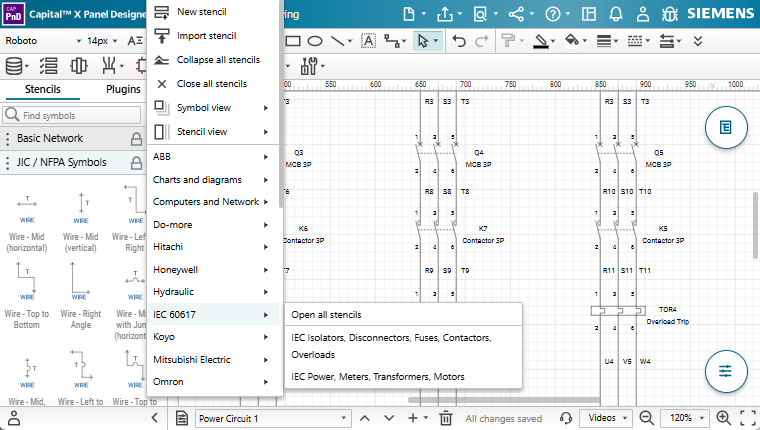
Capital X Panel Designer includes an extensive component and symbol library covering electrical, pneumatic, hydraulic, and P&ID standards, with more added regularly. Engineers can also create custom symbols using built-in drawing tools, and the software will automatically assign data and intelligence to turn them into schematic-ready components. This eliminates time spent searching for or manually recreating symbols from external sources.
3. Intelligent CAD Symbols
Modern Electrical CAD software goes beyond providing a library of symbols. Intelligent CAD symbols contain embedded engineering data, allowing components to be automatically identified, connected, referenced, and included in reports throughout the design process. This helps engineers maintain standard symbol design, improve design consistency, and support compliance and safety across projects that follow the IEC standard and JIC standard.
To learn more, read How Electrical CAD Symbols Create Smarter Design Fast.
4. Cross-referencing
Capital X Panel Designer provides real-time cross-referencing across all pages of a schematic, allowing engineers to instantly locate where any symbol or wire appears throughout the full drawing set. This is particularly valuable on large control panel projects where components span multiple sheets.
Cross-references update automatically as the design evolves, keeping documentation accurate without manual tracking.
5. Terminal and layout generation
Once the schematic is complete, Capital X Panel Designer can automatically generate terminal lists (a detailed summary of all connections and terminals used) with just a few clicks.
Panel layout drawings can then be generated directly from the schematic, organizing components and terminals into clear, buildable physical layouts. This reduces the manual handoff work between design and manufacturing teams.
6. Import and Export Capabilities
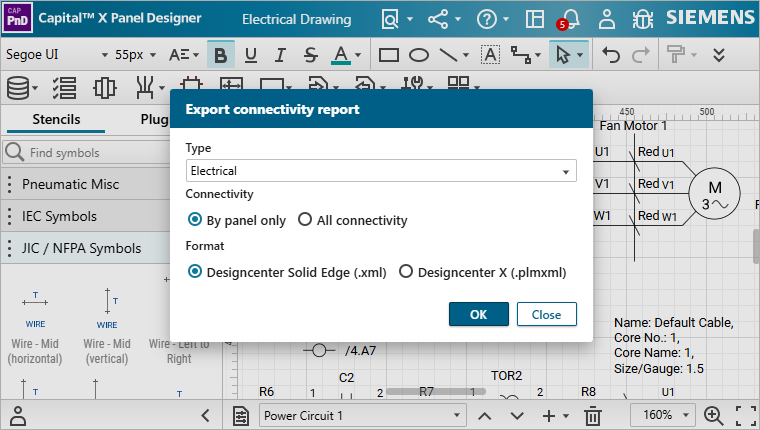
Capital X Panel Designer supports import and export data including DWG and DXF files, which can be dragged and dropped directly into the software and converted into native shapes. Reports such as Symbols on drawing, Wires on drawing, and Material reference reports can be exported as TSV, CSV or JSON for use in external spreadsheets and imported back after modification.
This makes it straightforward to integrate Capital X Panel Designer into existing design and procurement workflows.
7. Documentation
Capital X Panel Designer can automatically generate a full suite of engineering reports in a single click, including bills of materials (BOM) and cable BOM. These reports are dynamically linked to the schematic, meaning any design change is instantly reflected in the output, eliminating the need for manual updates. This ensures that manufacturing and documentation teams are always working from the latest version of the design.
What are the Key Automated Features of Electrical CAD Software?
Beyond these basic functionalities, electrical CAD software programs like Capital X Panel Designer also offer advanced automated features such as:
1. Electrical CAD diagram production and optimization
The primary attribute of electrical CAD software is its capacity to produce and optimize electrical CAD diagrams. Its core features include a comprehensive CAD symbol library, an automated terminal list generator, and an integrated setup for 2D and 3D electrical panel layouts.
Additionally, it incorporates autowiring, which automatically connects wires in a schematic based on user-defined rules when symbols are placed onto drawings.
These integrations improve productivity, enhance the technical drawings' quality, and optimize the electrical system design according to user-defined criteria like cost or performance.
2. Intelligent and automated CAD tools with advanced capabilities
Capital X Panel Designer offers advanced automated tools like:
Autowiring in Capital X Panel Designer automatically connects wires in a schematic based on pre-defined user rules, the moment a symbol is placed onto the drawing. Rather than manually routing each wire, the software intelligently determines the correct connection path and applies it instantly.
This eliminates one of the most time-consuming and error-prone steps in schematic design, particularly on large or complex control panel projects.
Automatic numbering assigns wire numbers and reference designators to symbols and connections without any manual input from the engineer. As the schematic grows, numbering updates dynamically to stay consistent and sequential.
This prevents human-error-related mismatches that can cause costly rework during manufacturing or commissioning.
When a symbol is dropped onto an existing wire in Capital X Panel Designer, the software automatically splits the wire at that insertion point and reconnects both sides cleanly around the new symbol.
Engineers no longer need to manually delete, reroute, or redraw wire segments around inserted symbols. This keeps schematics clean and accurate even as designs evolve throughout a project.
Capital X Panel Designer can automatically generate a full suite of engineering reports, including bills of materials and cable BOM, directly from the schematic with a single click.
Because reports are dynamically linked to the design, they update automatically when changes are made, ensuring that manufacturing and documentation teams are always working from the latest data. This eliminates manual export workflows and reduces the risk of version mismatches between design and documentation.
These features significantly reduce the time spent on generating electrical designs, allowing designers to concentrate on critical aspects of a design such as the control scheme, operations, and safety of the entire machine.
3. Seamless integration with CAD software and collaborative opportunities
Capital X Panel Designer emphasizes integrating with other software, such as CADENAS cloud part library to provide users direct access to millions of manufacturer-specific components within their design environment.
Furthermore, Capital X Panel Designer has also partnered with Designcenter Solid Edge, Designcenter X, Teamcenter and Capital Logic Designer to enable efficient coordination between Electrical CAD and MCAD designs.
The platform's real-time collaborative editor allows multiple engineers to work on the same schematic simultaneously, with changes reflected instantly for all users. This makes it practical for distributed teams to co-design across different offices or time zones without relying on file-locking or manual version control.
Access permissions in Capital X Panel Designer are fully customizable at the individual drawing level, making it straightforward to share specific schematics with external vendors, contractors, or customers without exposing the entire project.
As a cloud-native electrical CAD software, Capital X Panel Designer is accessible from any device (desktop or mobile) without the need for VPNs, physical servers, or complex IT setups. This makes it one of the few electrical CAD tools designed from the ground up for remote and hybrid engineering teams.
4. Comprehensive database functionality
The importance of a comprehensive database in electrical CAD software is paramount. Capital X Panel Designer provides access to a database of millions of manufacturers' parts with the CADENAS cloud part library.
This broad access ensures that designers have the necessary resources to create accurate and efficient designs, thus enhancing their project's precision and performance.
5. Achieving efficiency and precision
The cutting-edge automated features in Capital X Panel Designer propel the electrical design process to new heights of efficiency and precision. The software’s main automated features boast capabilities to create and optimize intricate electrical CAD diagrams, thanks to a robust CAD symbol library and functions like autowiring. The result is a streamlined design process that is more efficient and accurate.
Manual vs. Automated Electrical CAD Workflows
Electrical CAD workflows vary significantly depending on whether tasks are handled manually or through automation.
| Workflow Step | Manual CAD Workflow | Automated CAD Workflow |
| Wiring | Manually connect symbols | Auto-generated wiring |
| Numbering | Manual input and tracking | Automatic numbering |
| BOM Creation | Compiled manually | Auto-generated from design |
| Updates | Requires manual revisions | Updates synchronized automatically |
| Error Risk | High with complex designs | Reduced through automation |
Automated workflows reduce repetitive tasks, minimize errors, and improve consistency across panel designs.
How Capital X Panel Designer Supports Automated Electrical Design
Capital X Panel Designer automates the most time-intensive steps of schematic design, without requiring local installation or IT setup.
Key capabilities include:
- Automated design workflows: Handles wiring, numbering, and report generation to reduce manual effort
- Browser-based access: Run the full platform directly in a web browser with no installation required
- No IT overhead: Eliminates hardware constraints and deployment delays common in on-premise systems
- Faster project turnaround: Move from initial schematic to manufacturing-ready documentation with fewer manual steps
- Reduced handoffs: Keeps design, data, and documentation aligned within a single environment
This combination of automation and accessibility allows engineering teams to work faster, with greater consistency across projects.
Conclusion: Why Automation Matters in Electrical CAD Software
Electrical CAD software has shifted from manual drafting tools to automation-driven platforms. Features such as auto-wiring, automatic numbering, and real-time updates reduce engineering time, improve accuracy, and standardize outputs across projects.
For teams handling complex panel designs, automation is no longer a nice-to-have. It is essential for maintaining efficiency, minimizing errors, and scaling design workflows without increasing manual workload.
Electrical CAD software like Capital X Panel Designer reflects this shift, combining automation with browser-based access to deliver fast, consistent, and production-ready outputs.
Elevate your design process and experience unprecedented productivity, cost savings, and collaboration today. Sign up for a 30-day free trial.
Frequently Asked Questions (FAQs)
1. What is the difference between basic and automated features in Electrical CAD software?
Basic features help engineers create and edit electrical schematics, while automated features reduce manual work by automatically handling repetitive tasks such as numbering, documentation updates, report generation, and design validation. Together, they improve productivity throughout the design process.
2. Which automated features should electrical engineers look for in Electrical CAD software?
The most valuable automated features include automatic wire numbering, cross-referencing, BOM generation, terminal list generation, intelligent symbol management, reporting, and design rule checking. These capabilities help reduce manual errors and speed up project completion.
3. Does Electrical CAD software improve design consistency?
Yes. Electrical CAD software helps maintain consistency by applying standardized symbols, project rules, and automatic updates across schematics and reports. This reduces discrepancies that commonly occur when documentation is updated manually.
4. Can beginners use Electrical CAD software with automation features?
Yes. Modern Electrical CAD software is designed to help both experienced engineers and new users. Automation reduces repetitive manual work, allowing beginners to produce accurate electrical documentation while learning industry-standard design practices.
5. How does Capital X Panel Designer help engineers work more efficiently?
Capital X Panel Designer combines essential electrical drafting tools with intelligent automation, allowing engineers to complete repetitive tasks faster while maintaining accurate and up-to-date project documentation. This helps shorten design cycles and reduce manual effort.
6. When should companies upgrade to Electrical CAD software with advanced automation?
Companies should consider upgrading when manual documentation, repeated design updates, or increasing project complexity begin slowing engineering teams down. Advanced automation helps improve productivity, reduce errors, and supports larger electrical design projects more efficiently. Test drive Capital X Panel Designer FREE for 30 Days now!